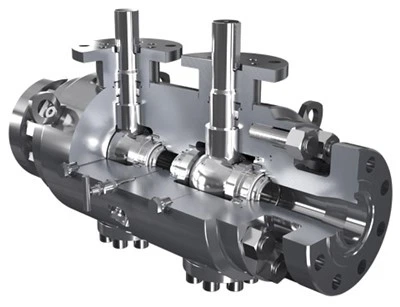
Hey there! I’m a supplier of fully welded side-entry trunnion ball valves. Today, I wanna talk about the difference between manual and electric fully welded side-entry trunnion ball valves. These valves are super important in a bunch of industries, like oil and gas, chemical, and water treatment. So, let’s dig in and see what sets these two types apart. Fully Welded Side-Entry Trunnion Ball Valve
Function and Operation
First off, let’s talk about how they work. A manual fully welded side-entry trunnion ball valve is, well, manual. You gotta use a handwheel or a lever to open and close it. It’s a simple and straightforward way to control the flow of fluids. You turn the wheel or lever, and the ball inside the valve rotates, either allowing the fluid to pass through or blocking it.
On the other hand, an electric fully welded side-entry trunnion ball valve is powered by electricity. It’s got an electric actuator that does the work for you. You can control it remotely using a control panel or a computer system. This is really handy in situations where you need to open or close the valve quickly or from a distance.
Control Precision
When it comes to control precision, the electric valve has an edge. With a manual valve, it’s all about your hand strength and how well you can turn the wheel or lever. It can be a bit tricky to get the valve to open or close to a specific position. You might end up overshooting or undershooting the mark.
But with an electric valve, you can set the exact position you want the valve to be in. The actuator can move the ball inside the valve with great accuracy, giving you much better control over the flow of fluids. This is especially important in industries where precise flow control is crucial, like in chemical processing or power generation.
Speed of Operation
Another big difference is the speed of operation. A manual valve can be pretty slow to open and close. You have to physically turn the wheel or lever, and it takes some time to get the valve to the desired position. This can be a problem in situations where you need to quickly shut off the flow of fluids, like in an emergency.
An electric valve, on the other hand, can open and close in a matter of seconds. The electric actuator can move the ball inside the valve at a much faster speed than you could with a manual valve. This makes it ideal for applications where rapid response is required, like in fire protection systems or in the control of high-pressure pipelines.
Installation and Maintenance
When it comes to installation, a manual valve is usually easier and cheaper to install. You don’t need to worry about electrical connections or wiring. All you need is a wrench to tighten the bolts and you’re good to go.
An electric valve, on the other hand, requires more complex installation. You need to connect it to a power source and a control system. This can be more time-consuming and expensive. But once it’s installed, it’s usually more reliable and requires less maintenance than a manual valve.
In terms of maintenance, a manual valve is relatively simple. You just need to lubricate the moving parts from time to time and check for any signs of wear and tear. An electric valve, on the other hand, requires more regular maintenance. You need to check the electrical connections, the actuator, and the control system to make sure everything is working properly.
Cost
Cost is always a factor when it comes to choosing a valve. A manual fully welded side-entry trunnion ball valve is generally cheaper than an electric one. The initial cost of the valve itself is lower, and the installation and maintenance costs are also less.
However, when you consider the long-term costs, an electric valve might be a better investment. It offers better control precision, faster operation, and more reliability. This can lead to cost savings in the long run, especially in industries where downtime can be very expensive.
Applications
The choice between a manual and an electric valve also depends on the application. A manual valve is a good choice for applications where the flow of fluids doesn’t need to be changed frequently. For example, in a water distribution system where the valves are only opened and closed during maintenance or repairs.
An electric valve is more suitable for applications where the flow of fluids needs to be controlled precisely and quickly. For example, in an oil refinery where the valves need to be opened and closed rapidly to control the flow of different types of oil.
Conclusion

So, there you have it! The main differences between a manual and an electric fully welded side-entry trunnion ball valve. Each type has its own advantages and disadvantages, and the choice depends on your specific needs and requirements.
Modular Double Block & Bleed (DBB) Valve If you’re in the market for a fully welded side-entry trunnion ball valve, I’d be happy to help you choose the right one for your application. Just drop me a line, and we can have a chat about your needs. Whether you need a manual valve for a simple application or an electric valve for a more complex one, I’ve got you covered.
References
- Valve Handbook, 4th Edition, by W. Powell
- Industrial Valves: Selection and Sizing, by R. K. Sinha
Platinum Valve (Zhejiang) Co., Ltd.
We’re well-known as one of the leading fully welded side-entry trunnion ball valve manufacturers and suppliers in China. Welcome to buy high quality fully welded side-entry trunnion ball valve made in China here from our factory. For customized service, contact us now.
Address: Heyi Industrial Zone, Oubei Town, Yongjia County, Zhejiang Province,China
E-mail: sales@platinumvalve.com
WebSite: https://www.topballvalve.com/
